
Electrical Tools in Bangladesh: A Practical Buying Guide for Electricians, Engineers & Technicians
If you've ever had to troubleshoot a "dead" outlet at 9pm with the wrong multimeter in your bag, you already know why tool selection matters. Electrical work doesn't forgive guesswork — the wrong tool doesn't just cost you time, it can give you a false reading on a live wire, or worse.
This guide covers the full range of electrical tools available in Bangladesh, category by category, with real product examples so you're not just reading theory. Whether you're searching for electrical tools price in Dhaka, trying to figure out which multimeter to buy in Bangladesh, or outfitting an entire maintenance crew, this should get you most of the way there.
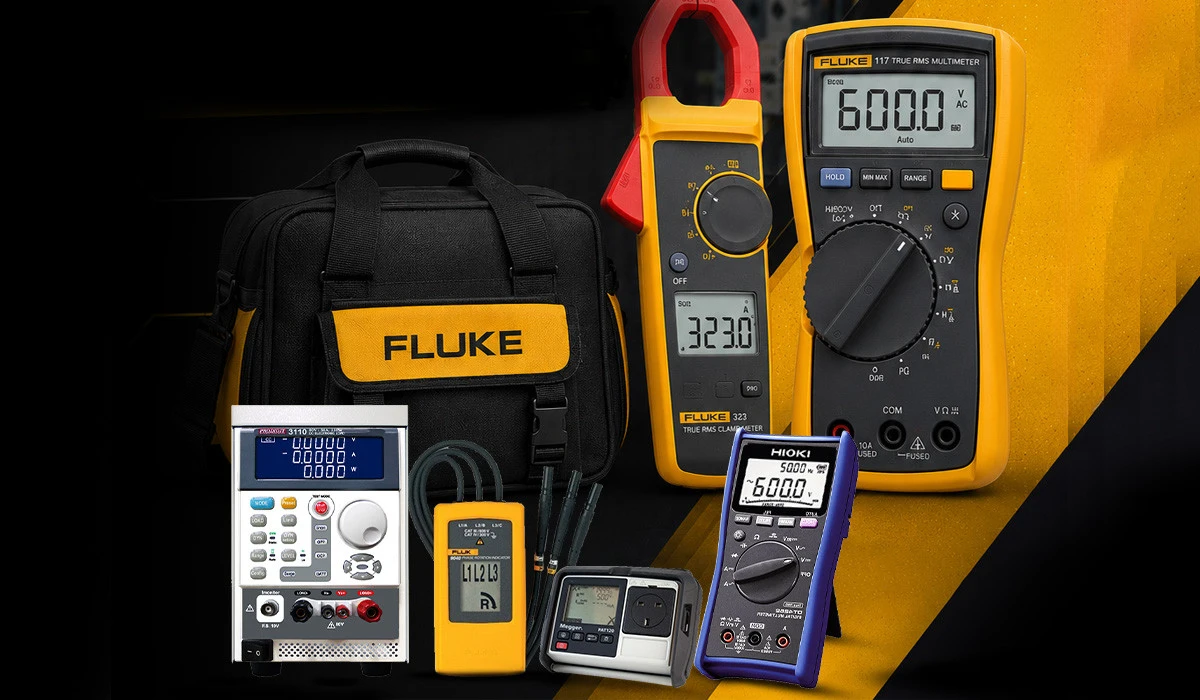
Tools Bangladesh (based in Kaptan Bazar, Wari, Dhaka) stocks internationally recognized brands — Fluke, Kyoritsu, Hioki, Proskit, Sanwa, Megger — so local electricians and engineers aren't stuck choosing between "cheap" and "available."
Why Tool Selection Actually Matters Here
A few things worth knowing before you buy anything:
- A bad reading is worse than no reading. An uncalibrated or low-quality meter can tell you a circuit is dead when it isn't. That's the scenario every electrician wants to avoid.
- CAT ratings aren't marketing fluff. CAT II, III, IV ratings tell you how much transient energy a tool is built to survive near a fault. Using a CAT II meter on a CAT IV panel is a real risk, not a technicality.
- Site conditions in Bangladesh are tough on tools. Dust, humidity, and voltage fluctuation take a toll on cheap gear fast. Industrial-grade tools cost more upfront but last through conditions budget tools don't.
- Compliance isn't optional for a lot of commercial work. PAT testing, insulation resistance checks, and earth loop testing are often required before a building passes inspection.
With that out of the way, here's the breakdown by category.
1. Meters & Test Instruments
This is where most of the buying decisions happen, and it's the category people search for most — "buy multimeter Bangladesh," "clamp meter price BD," that kind of thing.
Clamp Meters
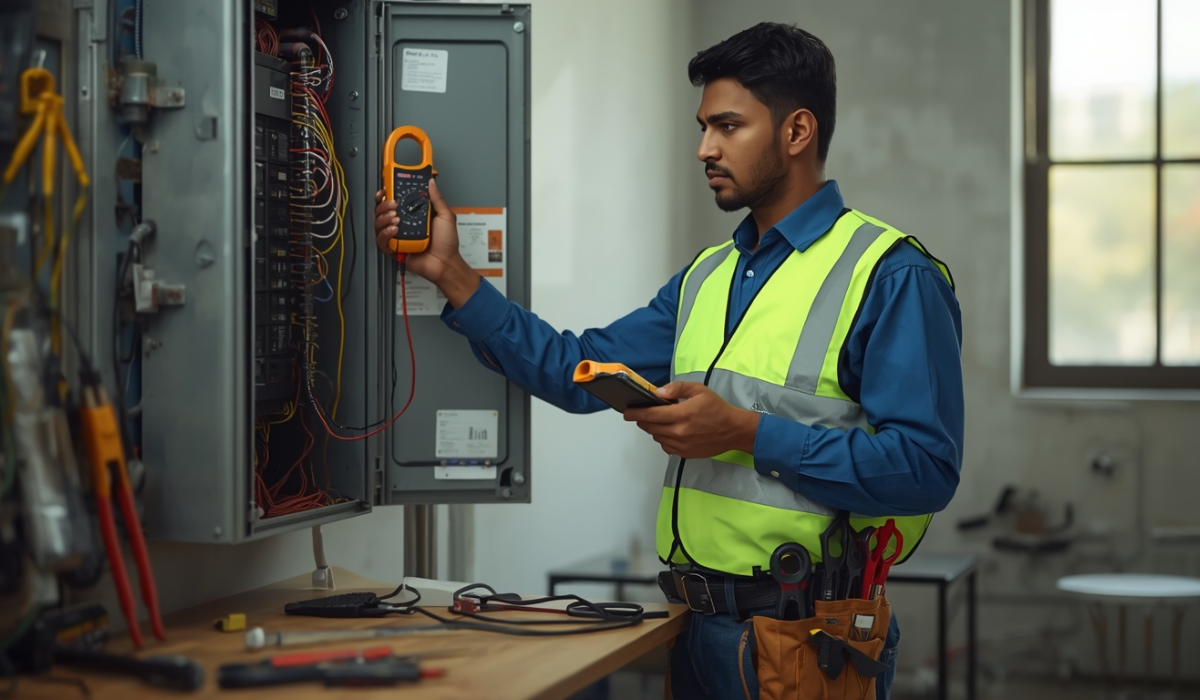
Clamp Meters measure current by clamping around a conductor rather than breaking the circuit — genuinely the safest way to check live current draw. If you want something built for heavier industrial loads, the Fluke 355 True RMS 2000A Clamp Meter handles high-current work; for tight or awkward spaces, the Fluke 381 Remote Display Clamp Meter with iFlex lets you clamp the jaws and walk away to read the display. Hioki's CM4371 AC/DC Clamp Meter is a solid mid-range option if you don't need Fluke's price tag.
Digital Multimeters
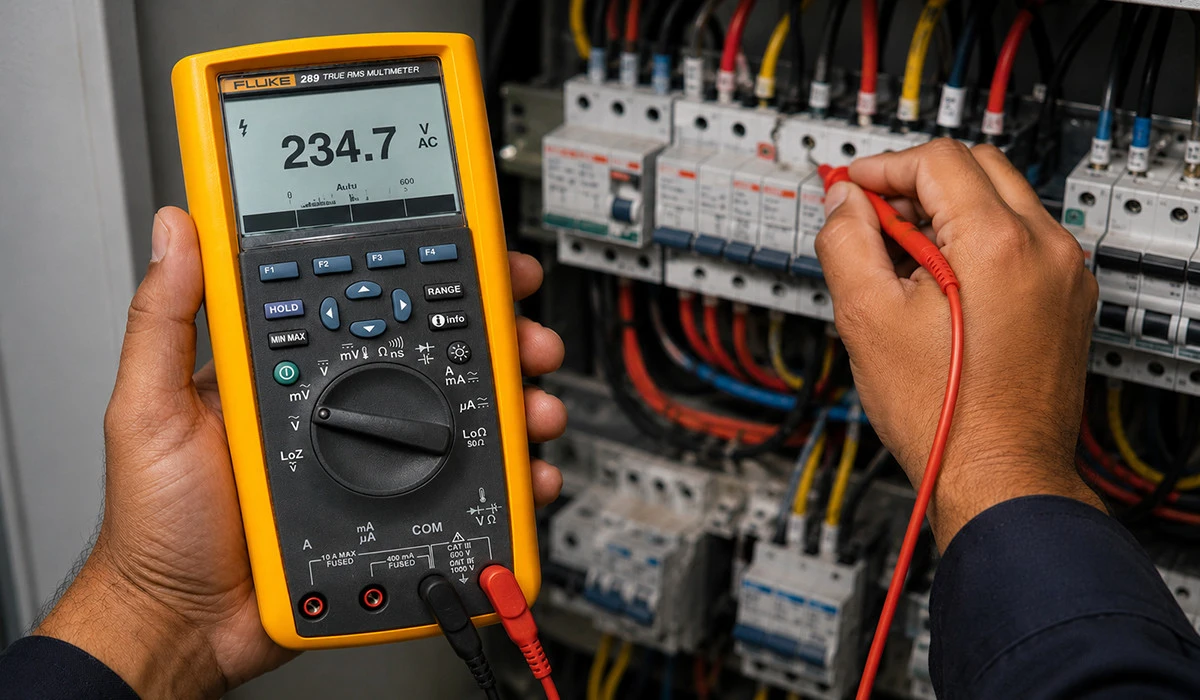
The Digital Multimeter is the one tool almost nobody skips. Voltage, resistance, continuity — it's the first thing reached for on nearly every call-out. For industrial troubleshooting, the Fluke 87V is the one most engineers already know by name; the Fluke 289 True-RMS Data Logging Multimeter adds trend logging if you need to catch an intermittent fault over time. On a tighter budget, Hioki's DT4212 and DT4221 models cover most field needs without the premium price.
Installation Testers
Installation Testers check that a new or reworked circuit is actually safe before it gets energized — earth loop impedance, insulation resistance, RCD trip time, that sort of thing. Kyoritsu's 4105A Digital Earth Tester is a common choice here, and it's dust/drip-proof, which matters more than people expect on outdoor installation work. For insulation resistance specifically, the Fluke 1503 and Fluke 1507 are both well-regarded.
Portable Appliance Testing (PAT) Testers
Portable Appliance Testing (PATs) equipment checks the electrical safety of things that get moved around a lot — power tools, extension leads, office electronics. It's mostly a compliance tool: offices, factories, and rental properties often need documented PAT testing on a schedule, not just when something looks wrong.
Oscilloscopes
Oscilloscopes show you voltage over time as a waveform, which is the only way to catch noise, distortion, or timing problems a plain voltage reading won't reveal. If you're already running a scope, a proper probe kit — like the Proskit 6HP-9150 Oscilloscope Probe Kit — is worth having on hand since stock probes wear out faster than the scope itself.
Bench Instruments
Bench Instruments — power supplies, function generators, bench-mounted meters — trade portability for precision. These live in the lab or workshop rather than the toolbag, and they're what you reach for when a field reading isn't accurate enough.
Phase Rotation Indicators
Wire a three-phase motor with the phases in the wrong order and it'll spin backward — sometimes with expensive consequences. A Phase Rotation Indicator, like the Fluke 9040, confirms the sequence is correct before anything gets powered up. It's a two-minute check that prevents a very expensive mistake.
Non-Contact Voltage Testers
Non Contact Testers detect voltage just by being held near a wire — no contact, no risk. This is usually the very first check before touching anything. Proskit's NT-303 and NT-309 are pocket-friendly and
Electrical Testers (General)
Electrical Testers is the catch-all category for continuity checks, socket testing, and basic fault-finding — the everyday, unglamorous tools that still get used constantly.
Laser Distance Meters
For site surveys, cable-run planning, or panel layout work, a Laser Distance Meter gives you an instant, accurate measurement without unrolling a tape across a busy site — a small time-saver that adds up over a full project.
Other Meters
Not every measurement fits neatly into the categories above. Other Meters covers the more specialized instruments — power analyzers, phase detectors, and similar niche devices — that specific trades need but general electricians rarely stock. Lutron's 3-phase power analyzers and Hioki's phase detectors are examples that live here.
Analog Meters
Digital dominates now, but Analog Meters haven't disappeared. Some technicians genuinely prefer a moving needle for spotting fluctuating or trending values in real time — a digital readout can actually be harder to read when a value is jumping around rather than settling on a number. They're also popular in teaching environments, where a visible needle sweep helps students understand what's actually happening in a circuit.
2. Hand Tools & Wiring Accessories
Meters tell you what's wrong. These tools let you actually fix it.
Precision Pliers & Electrical Pliers
Precision Pliers handle the fine, fiddly work — small connectors, delicate assemblies — while Electrical Pliers are built for heavier wiring: cutting, bending, gripping. Most working electricians carry both, since the two jobs rarely overlap.
Knives & Scissors
A decent Knife & Scissors set handles cable jacket cutting and insulation trimming — simple tools, but ones you'll reach for on nearly every job.
Crimpers & Strippers
Crimpers secure terminals and connectors onto wire ends; Strippers remove insulation cleanly without nicking the conductor. Together they're behind most of the reliable (or unreliable) connections you'll ever see — a bad crimp is one of the most common causes of an intermittent fault that takes hours to trace.
Punch Down Tools
Punch Down tools terminate wires into punch-down blocks for phone and network wiring — fast, consistent connections without any soldering involved.
Soldering Tools
Soldering equipment is what you turn to when a mechanical connection isn't reliable enough on its own — PCB work, electronics repair, anything needing a genuinely permanent, low-resistance joint.
Screwdrivers, Socket Wrenches & Hex Key Wrenches
No toolkit is complete without a good set of Screwdrivers, Socket Wrenches, and Hex Key Wrenches. For general electrical work, something like the Tolsen Electrician Tool Set bundles most of what you need in one go; for precision electronics, the Proskit SW-2125 Star Screwdriver Set or the Proskit SW-0118 15-Piece Set cover slotted, Phillips, hex, and Torx heads in one case.
Tool Cases
It's easy to underrate this one, but a proper Tool Case does more than keep things tidy — it protects sensitive meters and probes from the kind of drop or knock that ends their calibration early.
3. Advanced Inspection & Analysis Tools
For industrial, lab, and specialized applications, the requirements step up a level.
Borescopes
Borescopes let you see inside conduit runs, panel interiors, and other spaces you can't get a hand or eye into — without taking anything apart. Increasingly common in predictive maintenance programs, where catching a problem early is a lot cheaper than fixing it after failure.
General Purpose Testers
General Purpose Testers don't fit neatly into any one box, which is exactly the point — flexible, everyday testing capability for the jobs that don't need a specialized instrument.
LCR Meters & Impedance Analyzers
LCR Meters measure inductance, capacitance, and resistance with precision — essential for component testing and circuit design work. Impedance Analyzers go further, characterizing how a component behaves across a frequency range, which matters a lot more in R&D than in general fieldwork.
Test Fixtures, Probes & Sensors
Good measurements start with a good connection. Test Fixtures or Probes and Probes & Sensors keep contact with test points consistent — small detail, but it's the difference between a repeatable lab result and one you can't trust.
Impulse Winding Testers
Impulse Winding Testers check the insulation integrity of motor and transformer windings by finding weak spots before they turn into full insulation failure. If you 're in motor manufacturing or repair, this is a quality-control st ep that pays for itself the first time it catches a bad unit before sh ipping.
How to Actually Choo se the Right T ool
A short, practical checklist:
- Match th e tool to your real workload. A residential electrician and an industr
Why Buy From Tools Bangladesh
Tools Bangladesh carries a genuinely wide range of electrical tools from established international brands, with nationwide delivery and people who actually know the products well enough to help you choose. Whether you need one replacement multimeter or you're kitting out a whole maintenance team, browse the full catalog and see what fits.
Frequently Asked Questions
1. What tools should a beginner electrician buy first? A digital multimeter, a non-contact voltage tester, a clamp meter, a decent screwdriver set, and a pair of electrical pliers. That covers most basic diagnostic and installation work without overspending early on.
2. What's actually different between a clamp meter and a multimeter? A multimeter needs direct contact with the circuit through probes. A clamp meter reads current just by clamping around the wire — faster, and safer for live current checks.
3. Why does calibration matter so much for test instruments? Because a reading is only useful if it's accurate. In regulated or industrial settings, calibrated equipment is often required for audits and safety certifications — an uncalibrated tool can pass a fault that shouldn't pass, or fail a circuit that's actually fine.
4. Do tools bought from Tools Bangladesh come with a warranty? Yes, though it varies by brand and product — check the specific product page for the exact terms.
5. What's the best way to test old or existing home wiring? An installation tester paired with an insulation resistance check. That combination catches insulation degradation and earth faults that a basic multimeter simply won't detect.
6. What CAT rating do I need for household work? CAT II is usually enough for outlets and lighting circuits. For distribution boards or anything closer to the utility service entrance, go with CAT III or CAT IV.
7. Can the same multimeter measure both AC and DC? Most modern digital multimeters do both — just make sure you've selected the right mode and range before testing. Getting that wrong is a common source of misleading readings.





 Calibration
 HVAC/Clean Rooms
 Electrical
 Temperature Meters
 Power & Energy
 Mechanical & Maintenance
 Pharma, Health & Biomedical
 Drone Solution
 Networking
 Transformer & Relay Testing
 Insulation, Resistance and Battery
 Fault Testing & Diagnostics
 Lightning Protection Solution
 Education, Research & Development
 Civil Equipment
 Renewable Energy
 Cleaning and supplies
 Power Tools
 Safety Tools
 Hardwares
 Construction Supply
 Precision Tools
 Garden Tools
 Accessories
 Machines
 Hand Tools

Leave a Comment