
A friend of mine once said — “Working with electricity is a bit like walking in the dark. You can’t see it, but you can feel it.” He’s a bit of a dramatic person, but there’s truth in what he said.
Electricity is invisible. Its flow, its pressure, its resistance — none of it can be seen with the eye. And this is exactly where one small device changes the whole game. It’s called the Digital Multimeter, or DMM for short. Whether you’re an electrician, a hobbyist, or someone who just wants to find out why a wall socket has stopped working, a good digital multimeter quickly becomes the one tool you reach for first.
Key Takeaways
Before going deeper, here’s the short version — useful if you’re in a hurry or just need a quick reference:
- A digital multimeter (DMM) measures three core things: voltage (V), current (A), and resistance (Ω).
- Voltage is measured with the probes connected in parallel; current requires the meter to be inserted in series.
- Resistance should only ever be measured on a powered-off circuit.
- Ohm’s Law (V = I × R) ties all three values together — know any two, and you can calculate the third.
- The “count” rating (e.g., 4000 counts, 6000 counts) determines how precise a reading the meter can display.
- A higher CAT rating (CAT I–IV) means the meter is safer to use on higher-voltage or industrial circuits.
It Started With a Problem
In the old days, technicians used separate instruments — one for measuring voltage, another for current, a third for resistance. Carrying so many tools in a bag was a hassle, and each one required its own separate skill to use.
The Digital Multimeter combined these three functions into a single device. Not just combined — but made more accurate and easier to use. That one shift, from three bulky analog tools to a single handheld digital multimeter, is part of why the DMM became standard equipment in nearly every electrician’s toolbox.
What Does a Digital Multimeter Actually Measure?
In simple terms, a digital multimeter measures three main things: voltage, current, and resistance. Together, these three readings tell you almost everything you need to know about what’s happening inside a circuit.
Voltage — the “Pressure” of Electricity
Think of the pressure inside a water pipe — electricity works on a similar kind of pressure. This is called the Volt, or V for short.
Going a bit deeper — voltage is actually the difference in electrical pressure between two points. Just as water rushes from a high tank to a low tank because of pressure, electricity flows from high voltage toward low voltage. A home socket carries 220V, a mobile battery carries 3.7V, and a car battery carries 12V.
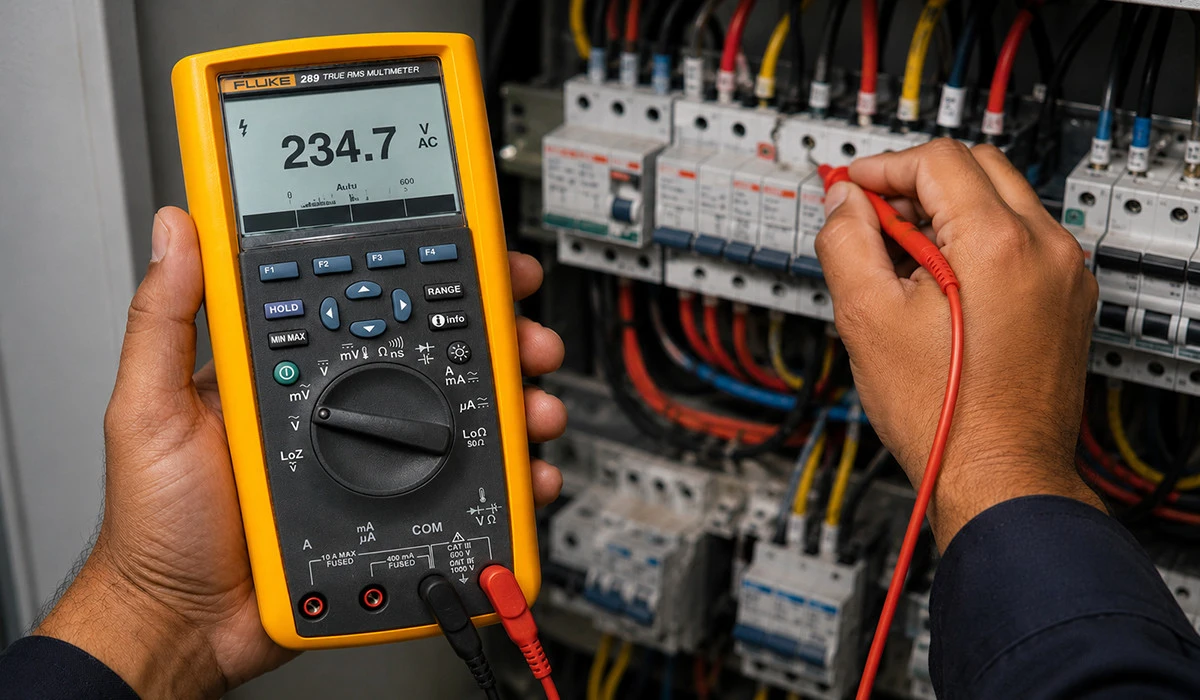
To measure voltage with a digital multimeter, you simply touch the probes to two points in the circuit — the circuit can stay on while you measure; you don’t need to switch it off. This is one of the most common multimeter tasks: checking whether a wall socket, battery, or charger is actually delivering the voltage it’s supposed to.
Current — the “Flow” of Electricity
Just as a certain amount of water flows through a pipe, a certain amount of electricity flows through a circuit — that’s current. It’s measured in Amperes, or A for short.
A word of caution here. When measuring voltage, the DMM is connected across the two points (Parallel), but when measuring current(clamp meter), the DMM must be inserted into the circuit itself (Series). If you mistakenly connect it in parallel while set to measure current, it can short-circuit and damage the multimeter, or even cause an explosion. So extra caution is essential when measuring current — this is one of the most common mistakes beginners make with a digital multimeter.
Resistance — the “Obstruction” of Electricity
How much an element obstructs the flow of electricity is measured in Ohms, with the symbol Ω.
Just as putting a stone inside a pipe reduces water flow, resistance does exactly that to electricity. A burnt-out resistor has either a very high resistance or an essentially infinite one (Open Circuit), while a short circuit has zero or near-zero resistance. For high-resistance or insulation testing in industrial equipment, a dedicated insulation resistance tester gives far more accurate results than a standard DMM.
Important point: resistance should always be measured with the circuit powered off. Measuring it on a live circuit gives incorrect readings and risks damaging the digital multimeter.
The Relationship Between the Three — Ohm’s Law
These three quantities aren’t separate from each other — they’re bound by a single formula. In 1827, the German physicist Georg Simon Ohm discovered this relationship:
V = I × R
This means voltage (V) = current (I) × resistance (R).
The practical meaning of this formula is — if you know any two of the three values, you can find the third. Suppose a bulb has 220V applied to it, and its resistance is 1000 Ohms — then the current would be 0.22 Amperes. This kind of calculation is everyday work for electricians, and it’s exactly why understanding how a digital multimeter measures all three values matters so much.
Not Just Three — Modern Digital Multimeters Can Do Much More
Today’s DMMs aren’t limited to just these three measurements. A better-quality digital multimeter also offers:
- Capacitance: measures how much charge a capacitor can hold. It’s the most reliable way to find out whether an old capacitor has gone bad.
- Frequency: how many times per second an AC current changes direction. In Bangladesh, the electrical frequency is 50 Hz, meaning it changes 50 times per second.
- Diode test: checks whether a diode is working properly and which direction it allows current to flow. It’s also useful for quickly checking whether an LED bulb is okay.
- Continuity test: tells you, with a beep sound, whether two points in a circuit are connected. Nothing beats it for finding a broken wire.
- Temperature: some high-end DMMs can measure temperature using a thermocouple attachment.
These extra functions are exactly why electronics hobbyists and professional technicians look for a multimeter with more than just the basic three measurements.
Impedance — A Topic Many People Skip
Any discussion of digital multimeters can’t avoid the topic of Impedance, even though it’s a somewhat technical subject.
In simple terms — Impedance is the overall “obstruction” to electricity flow in an AC ci
Why does this matter? Because when you connect a meter to a circuit, the meter itself becomes part of that circuit. If the m eter’s impedance is low, it will draw a significant amount of current itself, throwing off the reading. High impedance means the meter has minimal effect on the circuit — much like a good observer, who watches but doesn’t interfere.
Digital vs Analog Multimeter — Is There Really a Difference?
Old analog meters are still seen in many places. But why has the digital multimeter taken the lead?
In an analog meter, a needle moves and you have to read the value off a scale. This leaves room for reading errors. The needle can also drift if the temperature rises or the battery weakens.
A digital meter shows the number directly on screen. There’s no chance of misreading. The resolution is also far higher — some digital multimeters can detect a difference as small as 0.0001 volts. And the reading doesn’t drift with temperature or time.
Still, analog has one advantage — for rapidly changing signals, watching the needle move makes it easier to follow a trend. Experienced technicians sometimes prefer analog for this reason.
How to Use a Digital Multimeter (Step-by-Step)
A digital multimeter has four main parts:
- Screen — displays the reading
- Buttons — select the function
- Dial/switch — lets you choose what to measure
- Jacks — where the probes are plugged in
There are two probes — red (positive) and black (negative). These connect the meter to the circuit.
When measuring voltage: place the two probes in parallel across two points of the circuit.
When measuring current: connect the meter in series with the circuit — this distinction is very important.
When measuring resistance: disconnect the power from the circuit before measuring.
Common Mistakes to Avoid When Using a DMM
Even experienced users slip up sometimes, and a few mistakes come up again and again:
- Leaving the probes in the current (10A) jack while trying to measure voltage — this is one of the fastest ways to blow a fuse or damage the meter.
- Forgetting to switch the dial back to voltage after a current measurement, then touching the probes across a live circuit.
- Measuring resistance on a powered circuit, which gives a meaningless reading and can damage the multimeter’s internal circuitry.
- Using a meter with too low a CAT rating for the job — a household-rated meter has no business being used on industrial panels.
- Ignoring a low-battery warning, which can quietly skew every reading the digital multimeter gives you.
Most of these mistakes are avoidable simply by pausing for a second before touching the probes to anything, and double-checking the dial setting and jack placement.
Count and Resolution — The Story Behind the Numbers
Digital multimeter boxes often say “4000 counts” or “6000 counts” — you’ll notice these numbers at the shop, but many people don’t realize how important they actually are.
What Is a Count, Really?
Count refers to the maximum number the meter’s screen can display at once. Let me explain with an example —
Suppose your meter is rated 4000 counts. That means it can display up to 3.999 on screen (the 4000th step). Now, if you measure on the 4-volt range, the smallest change it can detect is 0.001 volts.
If the same meter is set to the 40-volt range, the smallest detectable change becomes 0.01 volts. As the range increases, the ability to detect small changes decreases — that’s the essence of resolution.
Digits vs Counts — Are They the Same Thing?
No, there’s a slight difference. Meter boxes sometimes say “3½ digit” or “4½ digit.”
“½ digit” means the leftmost digit can only be 0 or 1. So —
- A 3½ digit meter = can display up to 1999 = 2000 counts
- A 4½ digit meter = can display up to 19999 = 20000 counts
These days, though, most manufacturers list the count number directly, which is relatively easier to understand.
Where’s the Real Difference?
Picture a working scenario. You’re measuring the voltage of a circuit that should read 12.45 volts.
- A 2000-count meter would show: 12.4 volts (can’t capture the last two decimal places)
- A 4000-count meter would show: 12.45 volts (accurate)
- A 6000-count meter would show: 12.450 volts (even finer)
For a car battery or basic household work, this difference might not seem like much. But in electronics circuits, where a 0.01-volt difference can determine whether an IC works or not, you simply can’t get by without a high-count digital multimeter.
Which Count Do You Need for Which Job?
|
Use Case |
Recommended Count |
|
General home use |
2000–4000 |
|
Electronics hobby |
4000–6000 |
|
Professional technician |
6000–20000 |
|
Laboratory / calibration |
20000+ |
The simple rule is — the finer the work, the higher the count you need. But you shouldn’t buy a mul
Where Is a Digital Multimeter Used?
Digital multimeters are no longer limited to electricians’ hands alone.
In auto garages — mechanics check battery voltage, verify whether the alternator is working properly, and test sensor outputs.
At home — you can now check whether the correct voltage is coming from a wall socket, or whether a switch has gone bad, yourself.
In electronics labs — resistors, capacitors, and diodes are tested.
In solar panels — you can monitor how much electricity a panel is producing.
In industrial machinery — electrical faults in factory equipment can be tracked down quickly using a digital multimeter.
Safety Can’t Be Ignored: DMM CAT Ratings Explained
Working with electricity always demands caution. A few things to keep in mind when using a digital multimeter:
Every meter carries a CAT rating — from CAT I to CAT IV. A higher CAT rating means it’s suited for use in higher-voltage environments. For industrial work, a meter rated at least CAT III should be used.
If the probes aren’t plugged into the correct jacks while measuring current, the meter can be damaged, and it can even be dangerous. Reading the manual might feel tedious, but in this one area, it’s essential.
Which Type of Digital Multimeter Should You Buy?
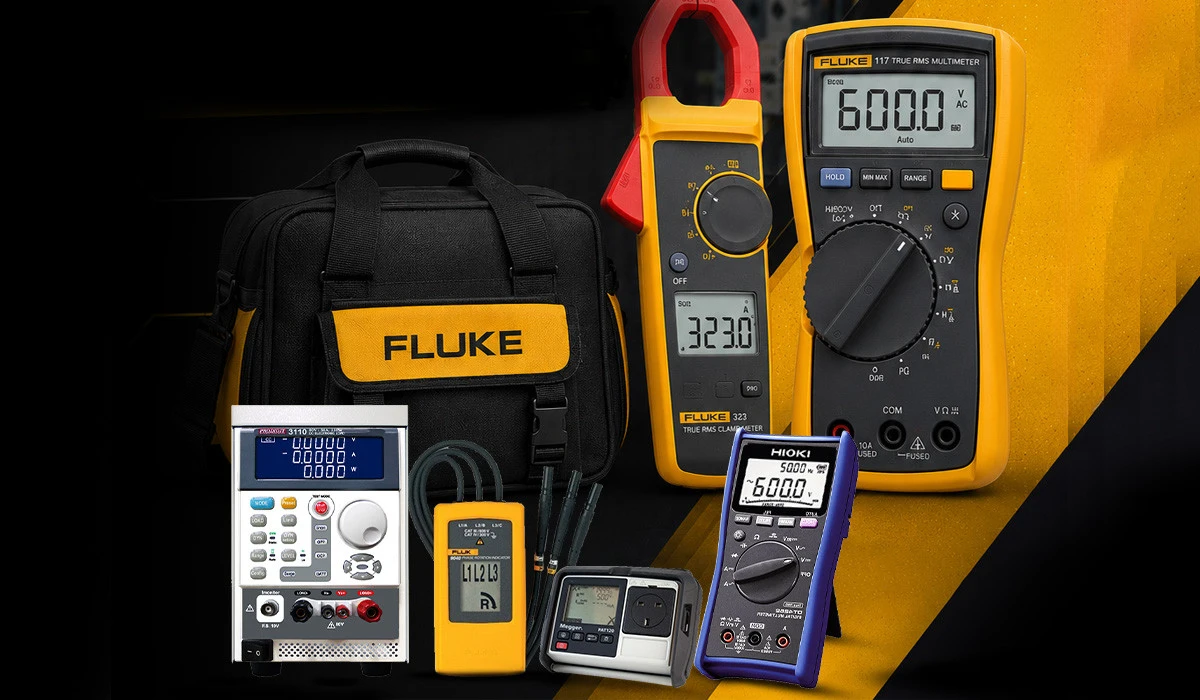
The market offers several types of meters:
General Purpose: lower price, basic measurements. Sufficient for household work.
Standard models: include extra features like frequency measurement and diode testing. Good for electronics hobbyists.
Advanced models: data logging, graphical display, ability to send data to a computer. Meant for professional work.
Wireless models: let you view readings on your phone via Bluetooth or Wi-Fi. Convenient for remote monitoring.
In solar panels — you can monitor how much electricity a panel is producing.
Frequently Asked Questions About Digital Multimeters
What is a digital multimeter used for?
A digital multimeter is used to measure voltage, current, and resistance in an electrical circuit. Better models also test capacitance, frequency, diodes, and continuity, which is why the DMM is one of the most versatile tools an electrician or hobbyist can own.
Can a digital multimeter measure both AC and DC voltage?
Yes. Most digital multimeters have separate settings for AC voltage and DC voltage, since the two behave differently. Always check that the dial is set to the correct one — AC for wall sockets, DC for batteries and most electronics — before measuring.
Is it safe to measure resistance on a live circuit?
No. Resistance should only be measured with the circuit powered off. Measuring it live gives an inaccurate reading and risks damaging the multimeter.
What does “count” mean on a digital multimeter?
Count refers to the highest number the meter’s display can show. A 4000-count multimeter can display up to 3.999, which determines how fine a reading — the resolution — the meter can capture at a given range.
What CAT rating do I need for home use?
For basic household work, a CAT II rated multimeter is generally sufficient. For industrial panels or higher-voltage work, a CAT III or CAT IV rated digital multimeter is recommended.
Why did my multimeter show 0 or a strange reading?
This usually comes down to one of a few things: the probes are in the wrong jacks, the dial is set to the wrong function, the circuit isn’t actually live, or the battery inside the multimeter is low. Working through these in order solves most “no reading” problems.
Final Thoughts
A Digital Multimeter is just a tool, but in the right hands, it can solve a great many problems. It can help you find out where an unexpected rise in your monthly electricity bill is coming from, pinpoint why your car suddenly stalled, or identify an electrical fault in a factory machine before it brings production to a halt.
Electricity may be invisible, but its story can still be read — if you have the right digital multimeter in your hand.







 Calibration
 HVAC/Clean Rooms
 Electrical
 Temperature Meters
 Power & Energy
 Mechanical & Maintenance
 Pharma, Health & Biomedical
 Drone Solution
 Networking
 Transformer & Relay Testing
 Insulation, Resistance and Battery
 Fault Testing & Diagnostics
 Lightning Protection Solution
 Education, Research & Development
 Civil Equipment
 Renewable Energy
 Cleaning and supplies
 Power Tools
 Safety Tools
 Hardwares
 Construction Supply
 Precision Tools
 Garden Tools
 Accessories
 Machines
 Hand Tools

Leave a Comment