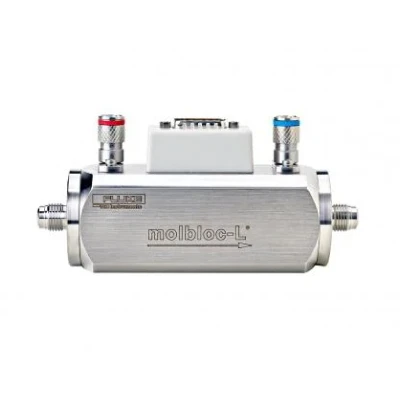
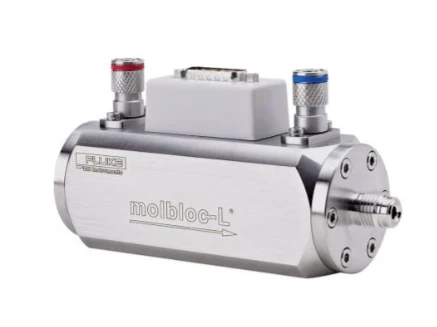
Product overview: molbloc-L Laminar Flow Element
Features at a glance
- Useable with existing molbox1+ and molbox RFM mass flow terminals and COMPASS software
- Integrated filter to protect against contamination
- Integral gas temperature conditioning and measurement
- Continuous, real-time reading
- Can be fully automated
- No moving parts
molbloc-L Ranges
molblocs sizes are designated by a number relative to their nominal flow impedance. The nominal impedance results in nominal flow ranges when flowing nitrogen gas with 250 kPa absolute (36 psia) upstream pressure and 50 kPa (7.5 psid) differential pressure across the molbloc. In practice, the molbloc flow range may be quite different from the nominal flow range. The difference comes from differences in density and viscosity between gases and from different molbloc operating pressure calibration options. Discover the Fluke Molbloc-L Laminar Flow Element price in Bangladesh—ideal for accurate low-flow gas calibration and testing.
Key features
- Flow ranging from 1 sccm to 100 slm.
- Molbloc flow path is the gap between a piston and a close fitting cylindrical bore in the molbloc body.
- Different flow ranges are achieved by varying the size of the gap, with larger bodies used for higher flow ranges.
Specifications: molbloc-L Laminar Flow Element
| Specifications - Standard molbloc-L Calibrations - Used with molbox1+ terminal |
| Measurement Update Rate |
1 second |
| Range |
0 to molbloc full scale depending on gas and molbloc pressure
dependent calibration type (see Section 1.2.5.1.3) |
| Resolution |
0.0015 % FS |
| Linearity |
± 0.05 % of reading from 10 to 100 % FS,
± 0.005 % FS under 10 % FS |
| Repeatability |
± 0.05 % of reading from 10 to 100 % FS,
± 0.005 % FS under 10 % FS |
| Precision1 |
± 0.07 % of reading from 10 to 100 % FS,
± 0.007 % FS under 10 % FS |
Stability2
(1 year) |
± 0.09 % of reading from 10 to 100 % FS,
± 0.009 % FS under 10 % FS |
| Measurement Uncertainty3 |
± 0.2 % of reading from 10 to 100 % FS,
± 0.02 % FS under 10 % FS |
| (N2 and any molbox1+ supported gas for which the molbloc in use is calibrated) |
1E5 molbloc
± 0.5% of reading from 25 to 100 % FS,
± 0.125 % FS under 25 % FS |
1 Precision: Combined linearity, hysteresis, repeatability.
2 Stability: Maximum change in zero and span over specified time period for typical molbox1+ and molbloc used under typical conditions. As stability can only be predicted, stability for a specific molbloc and molbox1+ should be established from experience.
3 Measurement uncertainty (accuracy): Maximum deviation of the molbox1+ flow indication from the true value of the flow through the molbloc including precision, stability and Fluke calibration standard measurement uncertainty. |
| Specifications - Premium molbloc-L Calibrations - Used with molbox1+ terminal |
| Measurement Update Rate |
1 second |
| Range |
0 to molbloc full scale depending on gas and molbloc pressure dependent calibration type (see Section 1.2.5.1.2) |
| Resolution |
0.0015 % FS |
| Linearity |
± 0.05 % of reading from 10 to 100 % FS,
± 0.005 % FS under 10 % FS |
| Repeatability |
± 0.05 % of reading from 10 to 100 % FS,
± 0.005 % FS under 10 % FS |
| Precision1 |
± 0.07 % of reading from 10 to 100 % FS,
± 0.007 % FS under 10 % FS |
Stability2
(1 year) |
± 0.03 % of reading from 10 to 100 % FS,
± 0.003 % FS under 10 % FS |
| Measurement Uncertainty3 |
± 0.125 % of reading from 10 to 100 % FS,
± 0.0125 % FS under 10 % FS |
| (N2 and any molbox1+ supported gas for which the molbloc in use is calibrated) |
1E5 molbloc-L Premium calibration not available |
1 Precision: Combined linearity, hysteresis, repeatability.
2 Stability: Maximum change in zero and span over specified time period for typical molbox1+ and molbloc used under typical conditions. As stability can only be predicted, stability for a specific molbloc and molbox1+ should be established from experience.
3 Measurement uncertainty (accuracy): Maximum deviation of the molbox1+ flow indication from the true value of the flow through the molbloc including precision, stability and Fluke calibration standard measurement uncertainty. |
































 Calibration
 HVAC/Clean Rooms
 Electrical
 Temperature Meters
 Power & Energy
 Mechanical & Maintenance
 Pharma, Health & Biomedical
 Drone Solution
 Networking
 Transformer & Relay Testing
 Insulation, Resistance and Battery
 Fault Testing & Diagnostics
 Lightning Protection Solution
 Education, Research & Development
 Civil Equipment
 Renewable Energy
 Cleaning and supplies
 Power Tools
 Safety Tools
 Hardwares
 Construction Supply
 Precision Tools
 Garden Tools
 Accessories
 Machines
 Hand Tools